
‘HOLLOW’ IN THE CAPEL May 2014
Jenny Hall
I was introduced to Avi Allen and Capel y Graig on a land journey curated by Simon Whitehead in 2012. Having descended, soaking wet, from low hanging cloud in the Cambrian hills I walked into the serenity of the restored Capel and rested mind and body.
I returned again recently. It remains as exquisite an offering as I had remembered.
 ‘Hollow’ prototype
Avi invited me to the Capel following a workshop I ran in early May that she attended called ‘Play, Space and Performance.’ Jointly run with my colleague Dr Andrew Filmer, a lecturer in the Dept. of Theatre, Film and Television at Aberystwyth University, the workshop sought to explore intersections between architecture, construction and theatre. We used lightweight modular cardboard boxes designed for sitting and standing on, that connect together and also fit comfortably in the arms of a child.
We explored how these boxes might form a modular theatre set that becomes an integral and malleable component of a performance.
The boxes also serve another purpose: they are a prototype for a new installation that I am researching: ‘Hollow’ makes visible the underground space left after mineral extraction. Its muse: a curvaceous 17th century copper mine.
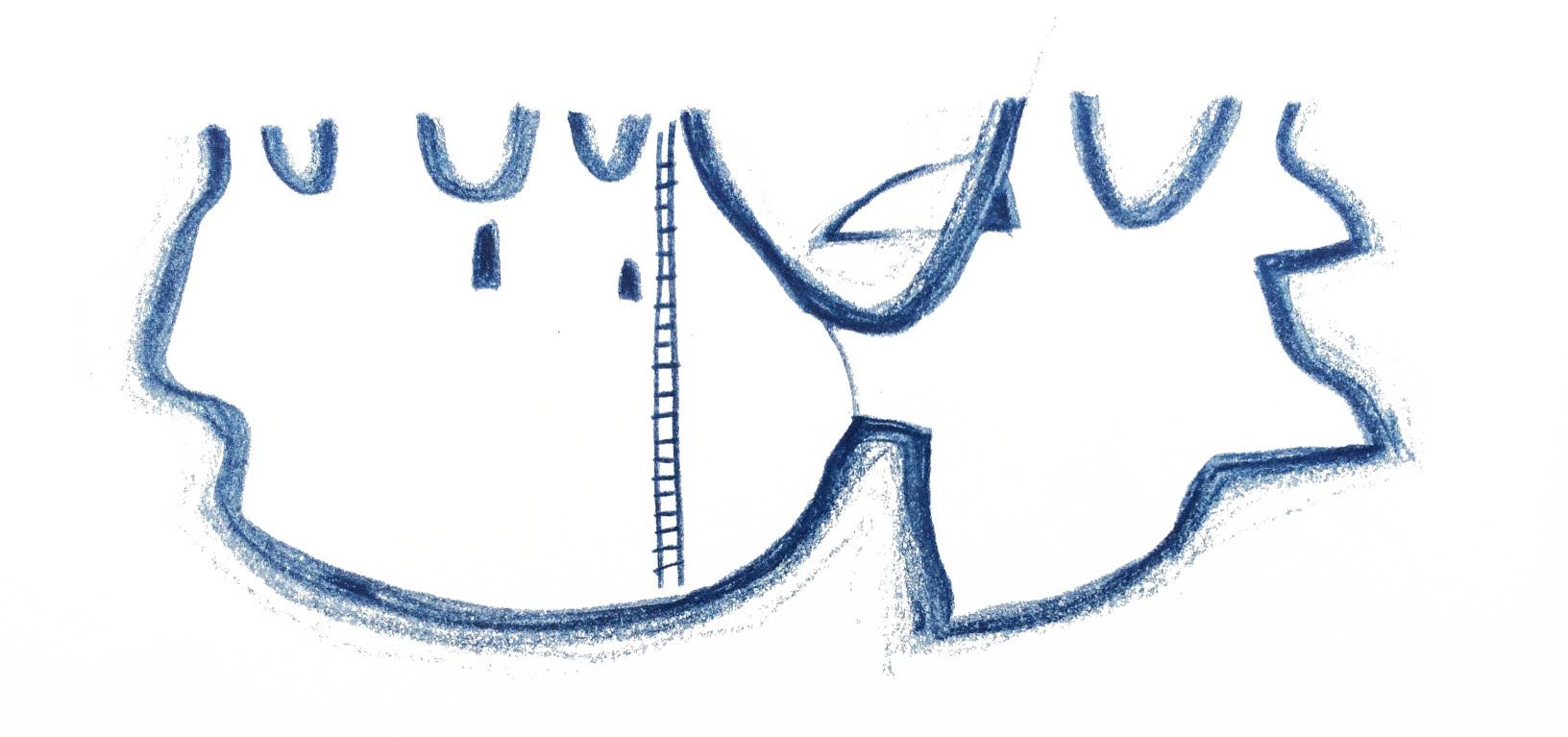
One of my sketches of the 1826 cross-section of Orijarvi copper mine
Over the winter I was artist-in-residence at Fiskars Village in Finland, a thriving arts and cultural space that was once alive with blast furnaces and molten iron. In the 17th Century, copper ore was smelted there that had been extracted from the local Orijarvi copper mine. The only record of this beautiful space is a draughtsman’s cross-sectional drawing from 1826. No data has since been recorded because the mine was flooded once exhausted.
We have burrowed underground for raw materials to build wealth. With which we have concentrated population and cultivated society. We have much to thank for the underground chambers that gave birth to life above ground.
I want to make visible these underground spaces that serve as a mirror of the culture above ground. Further I want to rationalise the organic, sensuous forms to restore the industrial drive behind their inception.
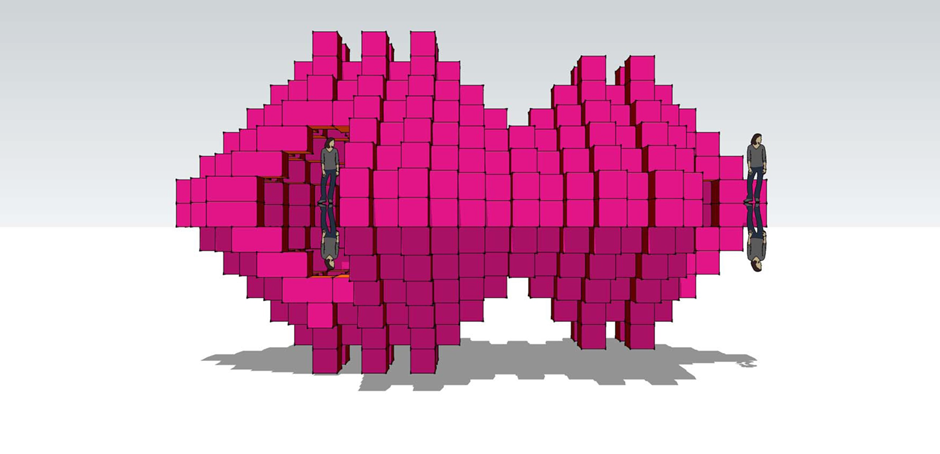
‘Hollow’ mirrored on a reflective surface (sketch up model)
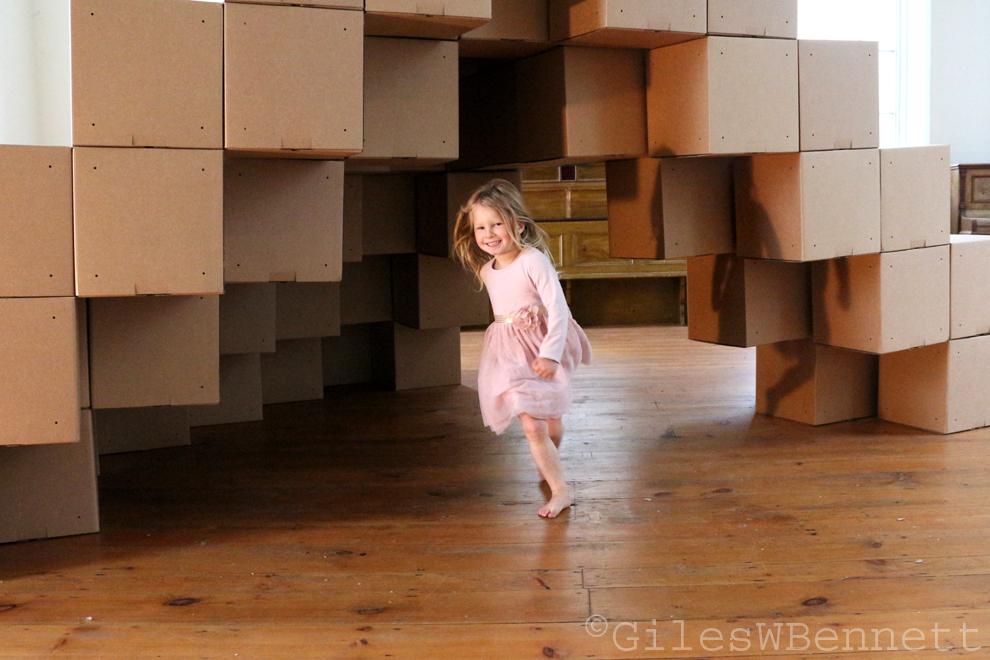 ‘Hollow’ prototype: a place for moving in, on and around
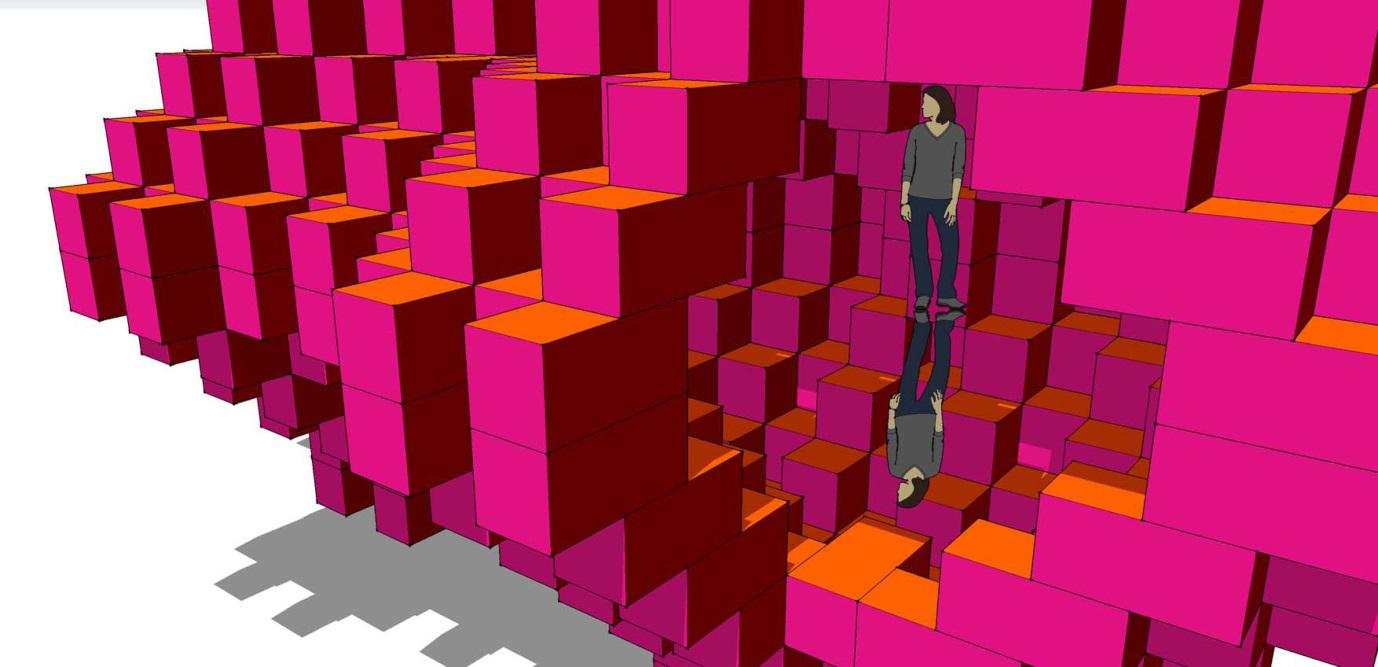 ‘Hollow’ interior (sketch up model)
I would like to create a regular rhythmic form that can be easily constructed, that can increase and decrease proportionally in steps. The cube lends itself to such a structure. Interestingly, Plato associated the earth with the cube.
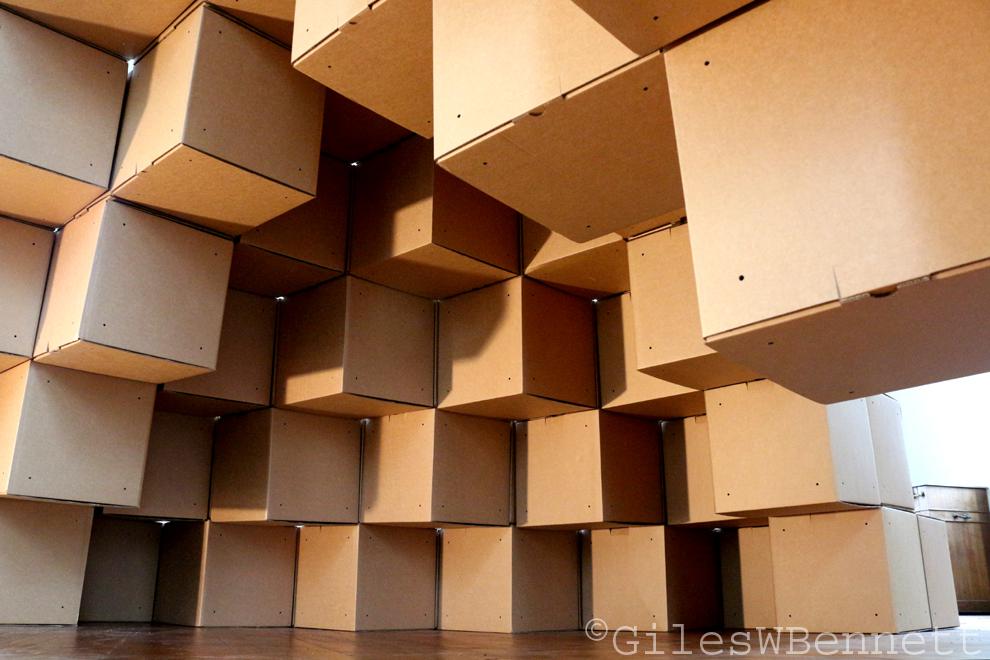 ‘Hollow’ research phase in Capel
I want to use small cardboard cubes to represent the analogue curves of Orijarvi mine as a series of steps. This simplification of the complex void allows it to be partially transmitted through time and space and made accessible today. Cardboard is both organic and industrial, capable of being rigid but also soft. It is tactile and it smells nice. During ‘Play, Space and Performance’ we found the box to be comfy to sit on, resonant to drum, scratch, sing and listen to: an ordinary sensory object of great potential.
‘Hollow’ will be constructed on a reflective surface so as to appear to float. Represented as a large scale architectural model, it is free from the earth that holds and hides its beauty. This allows the viewer to see the beauty of the underground mine as a discrete object.
Working in the Capel over three days I was able to develop ideas at an architectural scale that I had played with in the studio at my desk. I learnt the constructive and structural limitations of the system and brainstormed solutions. I was also able to see how the body interacts with the solids and voids created.
My daughter and friend came for the day and gave profound feedback in terms of what they intuitively wanted to do and play with. It is essential that the structure is robust and climbable and permits self-driven exploration.
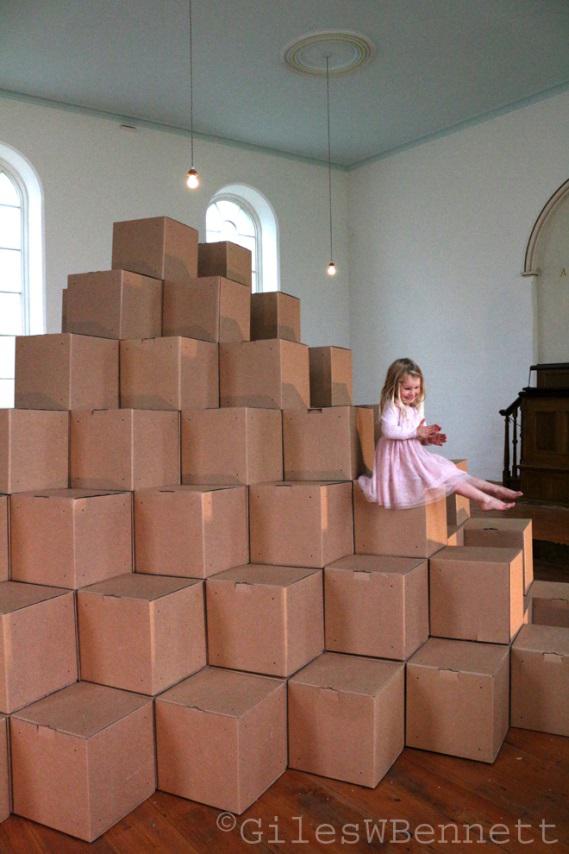

‘Hollow’ also needs to be juxtaposed with loose boxes that are scattered in the space that can be moved, stacked and appropriated. That enable the viewer to interact with the constructive and flexible potential of the material.
‘Moulding clay into a vessel, we find the utility in its hollowness; Cutting doors and
windows for a house, we find the utility in its empty space. Therefore the being of
things is profitable, the non-being of things is serviceable.’
From Chapter 11 of The Tao Te Ching
There is something gained from also seeing these ‘profitable’ goods juxtaposed with their ‘serviceable’ mirror: the hollow left behind.
‘Hollow’ is still work in progress but I’m very excited by the shapes it is taking and our journey. Orijarvi mine was not surveyed before it was closed but there are many accessible mines that could be three dimensionally surveyed and modelled both in Finland and in Wales that would be interesting to make visible too.
Dr Andrew Filmer made an interesting point about how mining could be catalogued as a series of forms that could map the evolution of mining technology. I’m intrigued to explore this subject at multiple scales and across different media to create an architectural study of the hollows beneath our feet.
With great thanks to Avi for creating this essential, loving arts space at Capel y Graig.


 Capel y Graig